
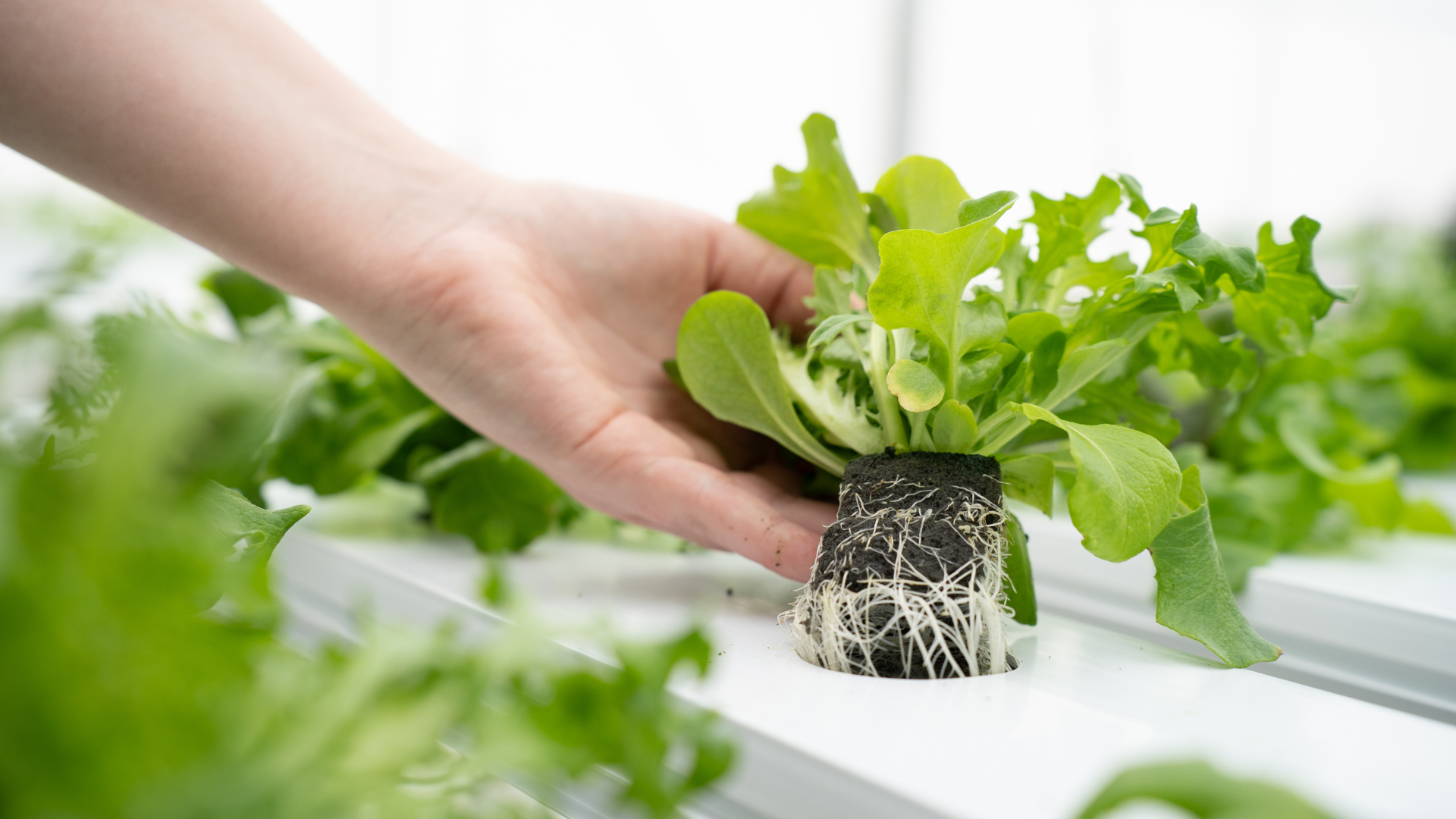
Sustainability and Engineered Foam Substrates
A Cradle-to-Grave carbon footprint assessment compares OASIS® AeroMax™ engineered substrate to two peat-based products, with surprising results. One of the most common questions we get asked about our engineered foam growing media relates to sustainability. We understand how important it is for growers to make environmentally sound choices in their propagation and production substrates. Sustainability is a primary concern for us here at Oasis Grower Solutions and our parent company Smithers-Oasis. This isn’t something new for us; it’s been a focus of ours for quite some time. Like many people — and many companies — we have come to realize that the sustainability of any product, including our engineered foam substrates, involves much more than raw materials and disposal. As such, it’s become increasingly important to us to understand the bigger picture surrounding the sustainability of our growing media, particularly the carbon footprint of the products we produce. To that end, we took the step to commission a Cradle-to-Grave carbon footprint assessment of our OASIS® AeroMax™ substrate after its 2021 launch (under the name OASIS® Horticubes® AeroMax). OASIS® AeroMax™ was the first in a new line of OASIS® AeroFamily Substrates, a line based on years of research and innovation here resulting in a new core technology and a new generation of engineered growing media. Now we’d like to share the results of that carbon footprint assessment with you. OASIS® AeroMax™ Carbon Footprint Assessment Details Our carbon footprint assessment of OASIS® AeroMax™ substrate was conducted by Carbon Footprint Ltd., a well-known U.K.-based company respected for their work. The study focused on the 2021-2022 production period. Because many of our current and potential customers use peat-based substrates, we requested a comparison of OASIS® AeroMax™ substrate’s carbon product footprint with two peat products: Gravity Filled Loose Plugs (our own gravity-fed stabilized peat plugs) and Pressed Peat. To determine the greenhouse gas emissions associated with OASIS® AeroMax™ and the two peat products mentioned, Carbon Footprint Ltd. conducted a full assessment following established Cradle-to-Grave carbon footprint boundaries for each product, including the following: extraction, processing and transport of raw materials manufacture, processing and packaging of product (including offcut waste) product distribution, usage and disposal relevant transport/freight elements OASIS® AeroMax™ Carbon Footprint Assessment Results The results of the carbon product footprint assessment, specific to OASIS® AeroMax™ substrate, can be seen in Table 1 below. The Cradle-to-Grave carbon emissions of OASIS® AeroMax™ engineered foam substrate were assessed to total 6.40 grams of CO2 equivalent emissions per Functional Unit (FU) — one 47.18 cm3 plug (3.175 cm x 3.90 cm x 3.81 cm). As noted, embodied emissions of raw materials accounted for more than 70% of that total. The results of the carbon footprint assessment’s plug-to-plug comparison can be seen in Table 2 below, again based on the Functional Unit of one 47.18 cm3 plug. The Cradle-to-Grave CO2 equivalent emissions of OASIS® AeroMax™ substrate, Gravity Filled Loose Plugs and Pressed Peat were assessed at 6.40 grams, 80.08 grams and 278.70 grams respectively. We’ll admit these results surprised even us. That’s one reason we’re only now releasing this report, a full year after it was complete. We took time to understand and confirm every aspect of the carbon footprint assessment. As you can see, the CO2 equivalent emissions for Pressed Peat were assessed at 278.70 grams per plug, more than 40 times higher than an equivalent OASIS® AeroMax™ plug. Gravity Filled Loose Plugs, at 80.08 grams of gCO2e per plug, were assessed as 12.5 times higher than an equivalent plug of our engineered substrate. What’s Next for OASIS® AeroFamily Substrates? Now that we’ve shared these results, you may be wondering what we plan to do with them. Well, we’re going to keep working to find ways to lower the carbon footprint of our next-generation engineered OASIS® AeroFamily Substrates even more — and our Gravity Filled Loose Plugs, too. At the top of the list is biodegradability, one of the many sustainability issues we have been focusing our Research efforts on. We will continue to bring sustainable innovations to the market. In the meantime, we’re grateful we undertook this carbon footprint assessment and gained a better understanding of the bigger picture about sustainability and our engineered substrates, for our own knowledge as well as yours. If you have any questions about the report and why Oasis Grower Solutions engineered substrates are environmentally sound choices for precision propagation and production, please contact us at [email protected] or call us at 855.585.4769. We welcome your call. Oasis Grower Solutions is a Division of Smithers-Oasis.

Why EthylBloc™? Protecting Plants and Profits
As long as commercial horticulture has been around, supply chain partners have battled ethylene-induced damage and loss. Found in almost all flowers and plants, ethylene gas supports many good things, like flowering, fruiting and ripening. But it’s also behind premature deterioration. Research shows ethylene damage such as accelerated flower aging, leaf yellowing, and foliage, flower and bud drop can constitute up to 30% of shrink — with margins already tight. Here at Oasis Grower Solutions, we’re focused on solving real-world problems with grower-driven innovations — like EthylBloc™. From growers to retailers to end consumers, everyone suffers when ethylene hurts plant quality and shelf life. But with EthylBloc™ ethylene-action inhibitor, high-quality plants maintain their quality through transport, at retail and beyond. Plants stay protected, and so do customer relationships and profits. Environmentally friendly. Worker-safe. EPA-approved. EthylBloc™ checks all the boxes. It’s the unsurpassed ethylene management you need. Born out of diligent research, including an industry-changing contribution by one of our Smithers-Oasis colleagues, EthylBloc™ has proven itself for decades. You can treat everything from loaded in-transit truck trailers to the smallest e-commerce box shipments — and rest easy and enjoy the ROI when you do. B.E. (Before EthylBloc™) Until EthylBloc™ was invented, horticulture and floriculture industry options to circumvent ethylene-related shrink were limited at best. To make matters worse, equipment and conditions that define modern commercial production, transport and storage add ethylene to the environment and amplify its negative impact. That makes delivering quality plants, flowers, vegetative cuttings or bulbs even tougher. Through the years, anti-ethylene options have spanned ethylene scrubbers focused on the surrounding environment, products to inhibit ethylene production in plants, and products that inhibit ethylene’s action. Commercial horticulture applications of products containing silver thiosulfate date back to the 1970s. But heavy metals such as silver have a set of problems all their own. Fortunately, not everyone was content with heavy-metal solutions to horticulture’s ethylene problem. In the 1980s, industry-focused North Carolina State University (NCSU) researchers began studying ethylene, seeking new ways to minimize ethylene sensitivity and maintain plant and flower quality through retail sell-through to consumers’ homes. Industry-Driven Solutions The NCSU research led to the development of a compound, structurally very similar to ethylene, destined to become the active ingredient in EthylBloc™. Known as 1-methylcyclopropene or 1-MCP for short, it worked naturally with plants by binding their ethylene receptors so that ethylene gas couldn’t lock into those receptor sites. The researchers knew they had something very special, but they needed a partner to further develop 1-MCP and bring it to commercial producers in an impactful, commercially viable way. That’s when the soon-to-be inventor of EthylBloc™ stepped in — our colleague Jim Daly, now Smithers-Oasis VP of Global FloraLife, Oasis Grower Solutions, and Research. In a major contribution to the horticulture and floriculture industries, Jim developed a carrier for 1-MCP — a cyclodextrin-based powder that, when wetted, would slowly release 1-MCP to block plants’ ethylene receptor sites. With Jim’s contribution, 1-MCP went from a ground-breaking development without a practical delivery system to an environmentally friendly, worker-safe product that could benefit every grower and retailer, large or small. EthylBloc™ Today From sachets designed to tuck into tiny shipping boxes and trolley trays to truck kits for large containers and spaces, EthylBloc™ can help you safeguard your shipments and your margins — and keep your customers happy, too. From tulip bulbs, roses and orchids to foliage plants and vegetative cuttings, EthylBloc™ delivers practical, cost-effective ethylene protection that’s safe and easy to use. Why wait? Make EthylBloc™ an integral part of your quality management system this year. Let us tell you more about how EthylBloc™ can help you reduce costly shrink and maintain plant and flower quality from your dock through retail to consumer homes. We’re Oasis Grower Solutions. Propagating Innovation. It’s what we do. EPA Reg. 71297-5-32258 ©2014 EthylBloc™ is a registered trademark of AgroFresh Inc. Not for use on food or food crops.

Our Poinsettia Connection: The Day Ecke Ranch Called
A VISION. A NEED. A SOLUTION. It’s no secret that poinsettias hold a special place in our hearts here at Oasis Grower Solutions (OGS). Around the world, these beloved plants are synonymous with holiday celebrations and Christmas cheer. But that wasn’t always the case. It took “Mr. Poinsettia” Paul Ecke, Sr. to leverage a revolutionary grafting technology and turn poinsettias into an enduring tradition. The story could have ended with California’s Ecke Ranch, but it didn’t. We’re very grateful we had a hand in helping the Eckes make poinsettias what they are today. V.L. Smithers had a vision. Smithers-Oasis, the parent company of Oasis Grower Solutions, was founded in 1954. That’s the year that Vernon “V.L.” Smithers revolutionized the floral industry with the creation of OASIS® Floral Foam. Even in those early years, V.L. envisioned a foam growing media that could help elevate plant growers to greater success. But it wasn’t until 1969 that we introduced our first propagation media for commercial greenhouse growers. It was called OASIS® O-903 Rooting Blocks. That single product launched what’s now known, nearly 55 years later, as Oasis Grower Solutions — OGS for short. The new foam propagation media offered stable pH, higher yields and uniform growth. Commercial greenhouse growers took note. Ecke Ranch had a need. Paul Ecke, Jr. was one of the growers who zeroed in on the new OASIS® propagation media. By the early 1970s, Ecke Ranch was the largest poinsettia supplier in the United States — probably the world. But while Paul Ecke, Sr. had focused on selling mother plants to growers, his son saw a new opportunity. Paul Ecke, Jr. saw the future. He urged his father to sell growers poinsettia cuttings instead. With rapid advances in jet air freight, the Eckes could ship their famed poinsettia cuttings to growers everywhere. In turn, those growers could get mature poinsettias to market more efficiently and profitably than ever before. But one hurdle stood in the way: Paul Ecke, Jr. didn’t have a rooting media he could trust to ship worldwide and stay intact. That’s when he reached out to us to develop the media he needed to accomplish the task. OGS had a solution. When Ecke called, our team at Smithers-Oasis was already focused on solutions to meet growers’ needs. The team rose to the challenge and started innovating. We developed a new foam substrate formula that allowed Ecke poinsettia cuttings to ship anywhere demand and duty called. Young plants from Ecke Ranch began shipping in the new OASIS® Rootcubes® Growing Medium to poinsettia growers everywhere. Other commercial growers paid attention and followed Ecke’s lead. Soon OASIS® Rootcubes® developed a loyal following. In the mid-1980s, we built our first research greenhouse at our Kent, Ohio campus. That facility laid the foundation for our Oasis Grower Solutions Research, Innovation & Development (RI&D) facility, built 10 years ago. It’s where new generations of engineered foam substrate, like our new OASIS® RhizoPlug™ products, and other grower-driven innovations are born. In the years since Ecke Ranch called and Oasis Grower Solutions answered, we’ve remained dedicated to inventing solutions that solve real-world problems for our customers. Leading poinsettia breeders and young plant growers worldwide still rely on OASIS® media for success. But our commitment to growers extends far beyond poinsettias. Whatever your crop, whatever your hurdle, we have a solution – or we’re ready to listen to your wish list. It just may spur something entirely new. We’re Oasis Grower Solutions. Propagating Innovation. It’s what we do.